Cruise Visitor Tours of Recife & Olinda

Recife Guide has delivered private tours to several groups of cruise visitors over the last year or so. We can offer tours by air-conditioned car or people carrier. The local driver / guides are all very experienced and certified guides that speak several languages.
Private tours can be arranged for couples and groups, small or large. We offer a standard itinerary, but can also offer customised itineraries to meet specific interests. The day can include a number of lunch options depending on your taste and budget, including the most interesting local cuisine.
Recife Guide already has several bookings for tours in 2011, with visitors arriving on the cruise liners MV Discovery and Aurora.
To start planning your day tour contact us with your enquiry
Carnival 2011
The 2011 Carnival in Brazil will take place between March 4th – 8th. Click the link for more information on the Carnival
Recife´s Markets
 Recife has several historic markets, each with it´s own character, architecture and stories. Most are house in historic buildings located in old and important neighbourhoods of the city. A few are visited by tourists occasionally, but they are not designed for tourists. They are thriving markets that serve local customers and for this reason are the best way to get a feel for the real an authentic life of the city and it´s people.
Go to Shopping Recife and you could be in most Shopping Centres or Malls of the world, characterless, soul-less and full of generic brands that you can find anywhere in Brazil or internationally with chains of fast food and franchise concepts that say nothing of Recife. Visit the old markets and you can see local and exotic produce, enjoy regional dishes, soak up the atmosphere and meet real people.

Fortunately you can find out more about each of the markets in an excellent bi-lingual (Portuguese & English) guide called Mercados do Recife (Recife´s Markets), published by Recifenobolso. It is available at good book stores and some select retailers for R$35. The well illustrated book tells the story of each market and brings it to life with anecdotes from traders, many of whom are the second and third generations of their families. They also talk of their customers and the changing times.
Recife guide offers walking tours that include a visit to some of these markets, and every visitor we have taken has appreciated the authenticity of the place. It´s sights, sounds, smells and characters. After a brief visit most people feel they know something of the real city, and get a sense of how the city was in the past.
Now we are collaborating with the publishers of Mercados do Recife to create guides tours of these markets; a closer look what they say about the city and it´s people, past and present. Within them it is possible to find references to many characteristics that typify the city and the region: it´s social life, folklore, musical, cuisine, religious traditions and so on.
The tours will be given by an experienced bi-lingual guide with in-depth knowledge of the city and all it´s stories. This guide will be your curator to the past and present real life of the city. after a half or one day tour you will already feel you know much about the place. If you do, we will have achieved the objective of the tour.
The tour should be available soon. In the meantime we recommend you buy the guide.
We will also be adding a series of market profiles to this guide over the coming weeks.
Tiradentes: The Day of a National Hero (21 April)

Tiradentes by Pedro Americo 1893
Written by Stephen Guild
Stephen Guild is Executive Editor of Recife Guide.
What is a Pousada?
The word pousada literally means “place to land” or “place to stay,” according to Hidden Pousadas, and there are literally thousands of them in Brazil.
The Origin of Pousadas
Readers may have heard of the Portuguese Pousadas. The state-owned Portugal Pousadas Group began in the 1940’s when the first regional pousada was created. Their website says the following:
“These beautiful hotels, often in superb locations, offer the visitor a sense of history, culture, tradition as well as regional hospitality and cuisine. The concept of the Pousada Group is the restoration of the national architectural heritage, in order to guarantee its preservation, and to increase the supply of first class accommodation. The Pousadas are uniquely Portuguese and represent the very best that Portugal has to offer. They are synonymous with elegant, luxurious accommodation with great attention to detail, exceptional service and a warm welcome.”
In the Pousadas of Portugal Pousadas Group, there are now over 40 hotels located throughout mainland Portugal, two in the Azores and one in Brazil. The group is divided into four categories: charm Pousadas, (regional architecture epitomizing local culture), nature Pousadas (outstanding countryside locations), historic design Pousadas (contemporarily restored historic monuments), and historic Pousadas (originally historic monuments).
Brazilian Pousadas
Pousadas in Brazil are different in a number of respects. Fundamentally, there are no pousada “chains” and, as Hidden Pousadas says, “they are all are individually run and managed. What they lack, sometimes, in terms of business administration and things like 24-hour room service, is more than made up for by charm, hospitality and personality.” This is especially true in the case of the good ones, since they are usually small, typically with less than 20 rooms.
Like the Portuguese Pousada Group, Pousadas in historic cities, such as Olinda, are often in restored old houses that ooze with charm. Others are in areas of natural beauty and try to be eco-friendly. By far, the largest group is those at the beaches.
In Brazil, the term pousada itself does not suggest a level of service or quality. Like hotels, guest houses, hostels or bed and breakfast places around the world, they vary a great deal in terms of price and quality. Some are very basic or just comfortable; others are very sophisticated and more akin to boutique hotels.
Price is generally a pretty good indicator of quality, when compared to others in the same destination, especially in popular destinations with a lot of competition. But prices vary considerably between the different regions of Brazil.
For travellers that are new to the pousada concept, I highly recommend you check out the Hidden Pousadas site. This is a good guide to staying in Pousadas and lists the better Pousadas that have all been checked out by the site owners Alison McGowan and Angela Karlson. The site gives detailed descriptions and commission-free online bookings – pretty handy if your Portuguese is not too good!
About Hidden Pousadas, Alison says, “There are thousands of Pousadas all over Brazil, ranging from the very simple to the extremely sophisticated, luxurious and expensive. More difficult is to know which ones are the nicest when there are so many to choose from. Initially following the recommendations of friends, we started the project looking at mid-range Pousadas in terms of cost, using the key criteria of comfort, quality, personal service, charm, and value for money.”
We prefer staying in a pousada rather than a hotel, except in larger urban areas. They are smaller places that are personal and cosy, and are worth giving up some of the facilities that hotels may offer in return. This may not be true if your are on a business trip, or mixing business and pleasure; but if you are on vacation, you may want to escape the corporate feel of a hotel.
A Typical Pousada
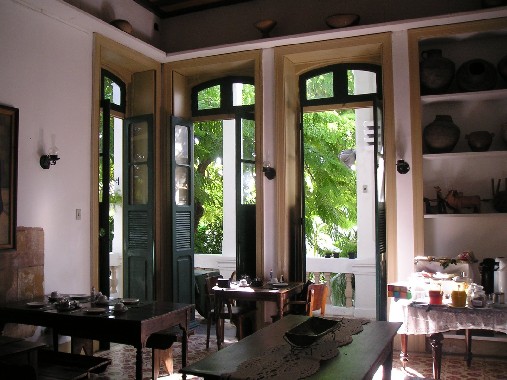
Pousada dos Quatro Cantos, Olinda (see Hidden Pousadas for details)
The Pousada dos Quatro Cantos is a good example. It is located right in the heart of Olinda, within walking distance from nearly all the best bars and restaurants. The pousada itself occupies a grand mansion and a listed building, dating back 120 years. All of the original features have been retained, from the high ceilings and huge floor to ceiling windows to beautifully tiled floors. As with all old houses, things don’t always work here, but the staff is, without exception, all helpful and charming, and in the end you just relax and let your worries disappear.
There are 18 suites but only six really do justice to the beauty and charm of the mansion in which they are housed. Try the luxo, luxo superior, or the suite rooms for a chance to experience the past in grand style and comfort, and the swimming pool and gardens for a leafy place to relax and unwind after all that hill walking visiting the sites.
There are many other similar posaudas in the Recife area, and throughout Brazil for that matter, that provide accommodations like this.
Recife Guide, in cooperation with Hidden Pousadas, can help you locate and book reservations at pousadas similar to this one during your stay in Recife and the surrounding area. We also offer Walking Tours to guests that stay in Pousadas in Recife and Olinda.
End of Carnival 2010

With the end of Carnival 2010, and new year in Brazil finally starts for many. From Christmas to New Year is a quiet time for business and trade here, being the middle of summer and the time many Brazilians take their annual holiday. For the tourism industry however, November to the end of March represents the busiest period, so still some time for travellers wishing to soak up the scorching rays of the Brazilian summer.
Of course Winter in Brazil (June-Sept), is Summer in Europe and USA, but tourists from these regions should not be put off visiting Brazil. They call it winter here, but north and northeast Brazil really has 12months of summer by European standards, and actually the temperatures in the ´winter´ are a much more comfortable 24-30C for those wishing to explore. The oceans of the northeast are also always tropically warm.

If you missed carnival and want to come to Brazil to party, there is always the Sao Joao festival in June. It is a kind of Harvest Festival or Thanks Giving religious celebration, and the second biggest party of the year with plenty of costumes and lots of music. Head to one of the cities that host the big parties to celebrate this in style.

Of course for many a trip to Brazil is not about carnival and parties. There is far more to do and see, such as explore the countries rich colonial heritage. You can get inspiration in this guide, or take a look at www.pearltravelguides.com, our main site, for guides to other parts of Brazil including Rio, Florianopolis, Salvador and more.


 recifeguide.wordpress.com
